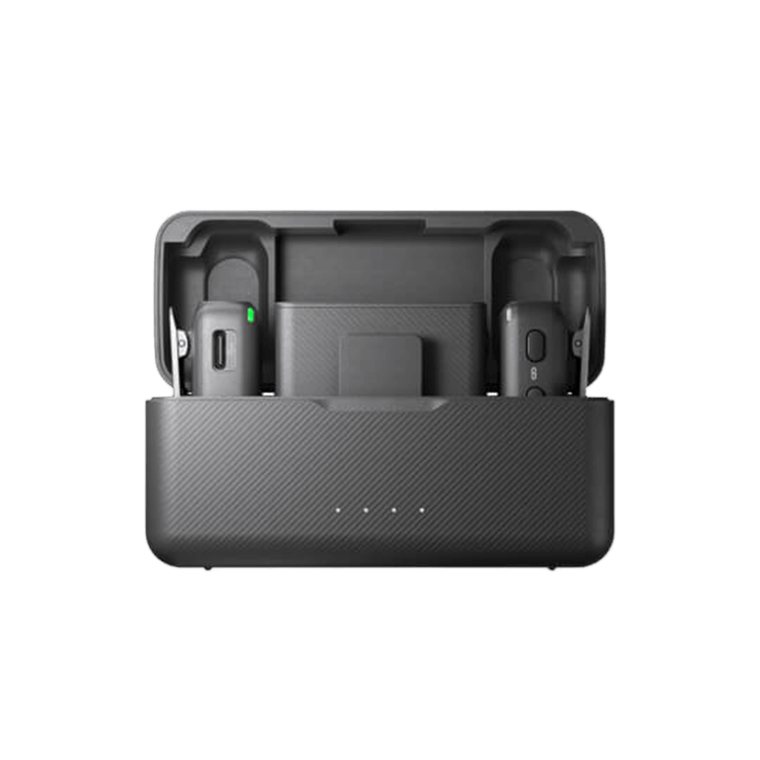
Six microphones, one clip-on shape, and a spec sheet that quietly changed underneath it. Here is the whole DJI wireless line side by side — the original Mic, Mic 2, Mic Mini, Mic 3, and the two 2026 Minis you cannot yet buy in the States — with every published spec, every firmware feature I could confirm from the manuals, and the numbers that actually decide a shoot.
Words by Kaulike JansenPublished 8 August 2026Reading time 12 min
The current shape of the line: four DJI Mic 3 transmitters, 16 g each. Product photography courtesy of DJI.
01 · The short answer
Skip to the end.
Most people asking “which DJI mic” are really asking one question: do I need the transmitter to record on its own? That single feature splits the line cleanly in half, and it is worth more on a real shoot than any other number on the sheet.
Until this year that line also split cheap from expensive. The Mic Mini 2S, launched worldwide four days before this was written, breaks that rule — it puts 14.5 GB and 32-bit float inside a 12 g transmitter. It is also not sold in the United States, which is why the recommendations below still read the way they do.
Buy this one
DJI Mic 3
32 GB onboard, 32-bit float, real timecode and four transmitters to one receiver. The only one in the line I’d put on a paid interview without a backup plan.
Buy this instead if money is tight
DJI Mic 2
Still records 32-bit float to 8 GB onboard. Older, heavier, no timecode — but it keeps the one feature that saves takes, usually for a good deal less.
Buy this one for travel
DJI Mic Mini
10 g, 48 hours on a case, 400 m of range, and genuinely invisible on camera. No onboard recording at all — so it lives or dies on the wireless link. The Mini 2S fixes exactly that, if you can get one.
Don’t buy this one
DJI Mic (2022)
Discontinued, 24-bit only, and the shortest battery in the line. Worth owning only if it’s already in the bag or someone hands you one cheap.
The whole line, in numbers.
Six wireless microphones 2022 – 2026 · Specs per DJI Compiled by Kaulike Jansen
A · The six models
What each one is for
Every kit below is the standard 2 TX + 1 RX + charging case configuration. Prices are typical street prices checked August 2026 and move constantly — treat them as a band, not a quote.
2022Discontinued
DJI Mic
The original
TX weight
30 g
Onboard
8 GB · 24-bit
Range
250 m
With case
15 h
Timecode
—
Used / clearance only
2024
DJI Mic 2
The value pick
TX weight
28 g
Onboard
8 GB · 32-bit
Range
250 m
With case
18 h
Timecode
—
approx. $199
2024
DJI Mic Mini
The travel pick
TX weight
10 g
Onboard
None
Range
400 m
With case
48 h
Timecode
—
approx. $169 list
2025Best overall
DJI Mic 3
The flagship
TX weight
16 g
Onboard
32 GB · 32-bit
Range
400 m
With case
28 h
Timecode
Yes
approx. $259–329
2026Not sold in US11 gSwappable magnetic covers · still no onboard recorder
DJI Mic Mini 2
The dress-code pick
TX weight
11 g
Onboard
None
Range
400 m
With case
48 h
Timecode
—
from £89 / €89
2026Not sold in US14.5 GBThe Mini that finally records itself
DJI Mic Mini 2S
The spoiler
TX weight
12 g
Onboard
14.5 GB · 32-bit
Range
400 m
With case
40 h
Timecode
—
from £169 / €189
The two 2026 Minis are the newest hardware in the line and the hardest to buy: as of August 2026 DJI’s US store returns “not available in your country/region” for both, and neither has a US product page. They are in every table below because they are part of the line — not because you can order one from San Diego today.
B · Actual size
The transmitter shrank by half
Transmitter faces drawn to scale from DJI’s published length × width. This is the difference between a mic your subject forgets about and one they keep touching.
← Scroll the diagram sideways →
Drawn at 3 px per mm · transmitter face only, excluding windscreen and clip · the Mic Mini 2S is absent because DJI has not published its dimensions — only its 12 g weight
C · The numbers that move
Battery, range, storage
Three specs where the generations genuinely separate. Everything else on the sheet moves by a decibel or two.
FCC figures · CE-region Mic / Mic 2 are rated 160 m · Mic 3 falls to 80 m in heavy interference · on the pocket-sized Mobile Receiver the Mini 2S drops to 300 m or 200 m depending on mode
Onboard recording
Storage inside each transmitter · GB
DJI Mic8 GB
Mic 28 GB
Mic MiniNone
Mic 332 GB
Mic Mini 2None
Mic Mini 2S14.5 GB
Hatched row = no internal recorder at all
D · The full sheet
Every published spec, side by side
Figures are DJI’s own, taken from the specification and FAQ pages for each product in August 2026.
DJI wireless microphone specifications — all six models, 2022–2026
Spec
DJI Mic 2022
Mic 2 2024
Mic Mini 2024
Mic 3 2025
Mic Mini 2 2026
Mic Mini 2S 2026
Recording
Internal storage
8 GB
8 GB
None
32 GB
None
14.5 GB
32-bit float
No
Yes
No
Yes · dual-file
No
Yes
Bit depth
24-bit
24 / 32-bit float
24-bit
24 / 32-bit float
24-bit
24 / 32-bit float
Onboard capacity
14 h 24-bit
14 h · 11 h float
—
57.3 h · 43 h float
—
28 h · 22 h float
Sample rate
48 kHz
48 kHz
48 kHz
48 kHz
48 kHz
48 kHz
Timecode
No
No
No
Yes · 23.98–60F
No
No
Safety track (−6 dB)
Yes
Yes
Yes
—
Yes · in app
—
Audio
Max SPL
114 dB
120 dB
120 dB
126 dB @1% THD
120 dB
—
Equivalent noise
23 dBA
21 dBA
24 dBA
22 dBA
24 dBA
—
Frequency response
50 Hz–20 kHz
50 Hz–20 kHz
20 Hz–20 kHz
20 Hz–24 kHz lossless
20 Hz–20 kHz
—
Low-cut filter
150 Hz
100 Hz
100 Hz
100 Hz
100 Hz
—
Polar pattern
Omni
Omni
Omni
Omni
Omni
Omni
Signal-to-noise
—
—
—
72 dB
—
—
Noise cancelling
None
1 level
2 levels
2 levels
2 levels
2 levels · AI
Wired lav input on TX
3.5 mm
3.5 mm
None
None
None
None
Wireless
Range (FCC)
250 m
250 m
400 m
400 m
400 m
400 m
Range (CE)
160 m
160 m
—
—
—
—
High-interference range
—
—
—
80 m
—
—
Band
2.4 GHz
2.4 GHz
2.4 GHz
2.4 + 5 GHz
2.4 GHz
2.4 GHz
TX per receiver
2
2
2
4
2
4
RX per transmitter
—
—
—
8
—
—
Output channels
2
2
2
4
2
4
Bluetooth version
—
BR/EDR
5.3
5.4
—
—
Size & weight
Transmitter (mm)
47.3×30.4×20.0
46.1×31.0×21.8
26.6×26.1×16.0
28.8×28.3×16.4
28.6×28.0×13.5
—
TX weight
30 g
28 g
10 g
16 g
11 g
12 g
Receiver (mm)
47.4×32.2×17.4
54.2×28.4×22.5
46.5×29.6×19.3
53.9×28.7×22.0
—
—
RX weight
24.9 g
28 g
17.8 g
25.1 g
—
—
Case weight
162.2 g
200 g
139 g
164.1 g
—
—
Power
TX battery
5.5 h
6 h
11.5 h
8 h
11.5 h
11 h
RX battery
5 h
6 h
10.5 h
10 h
10.5 h
10 h
Total with case
15 h
18 h
48 h
28 h
48 h
40 h
TX charge time
70 min
70 min
90 min
50 min
—
70 min
Operating temp
−10 to 45 °C
−10 to 45 °C
−10 to 45 °C
−10 to 45 °C
—
—
Status
Released
2022
Jan 2024
Nov 2024
Aug 2025
Apr 2026
Aug 2026
US availability
Discontinued
Current
Current
US retailers only
Not sold in US
Not sold in US
Kit price (approx.)
—
$199
$169 list
$259–329
£89 / €89 from
£169 / €189 from
← Scroll the table sideways →
E · The part that isn’t on the box
Software & control, feature by feature
Two mics with identical microphone specs can behave completely differently on a shoot. This is every firmware and app-level capability I could confirm from DJI’s user manuals — the settings menus, the button behaviours, and what the receiver will actually let you do.
Firmware, app and control features — confirmed from DJI user manuals
Capability
DJI Mic
Mic 2
Mic Mini
Mic 3
Mini 2
Mini 2S
Recording control
Records inside the transmitter
Yes
Yes
No
Yes
No
Yes
32-bit float toggle
—
Yes
—
Yes
—
Yes
Dual-file (raw + processed)
—
—
—
Yes
—
—
Loop recording / auto-overwrite
—
—
—
Yes
—
—
Auto-record on power-on
Yes
Yes
—
Yes
—
—
Auto-record when host battery dies
—
—
—
Yes
—
—
Start / stop from TX button
Yes
Yes
—
Configurable
—
—
Record-stop lock
Yes
Yes
—
—
—
—
Gain & processing
Manual transmitter gain
Yes
Yes
In app
Yes
5-level
Yes
Manual receiver gain
Yes
Yes
Dial
Dial + slider
Dial
Yes
Adaptive Gain Control
—
—
—
Auto + Dynamic
—
—
Automatic limiting
—
—
Yes
—
Yes
Clipping Control
Loudness balance
—
—
—
—
—
Yes
Voice tone presets
—
—
—
3
3
3
Lossless transmission mode
—
—
—
48 kHz / 24-bit
—
—
Indoor / outdoor RF mode
—
—
—
Yes
—
—
Channels & sync
Mono / stereo modes
Yes
Yes
Yes
Yes
Yes
Yes
Safety track
Yes
Yes
Yes
—
Yes
—
Quadraphonic (4 discrete)
—
—
—
Yes
—
Yes
Timecode in / out
—
—
—
L-IN / L-OUT / A-OUT
—
—
Multi-receiver group
—
—
—
Main + secondary
—
—
Receiver hardware & UI
Screen
OLED touch
Touchscreen
LEDs only
Touch + dial
LEDs only
—
Headphone monitor port
Yes
Yes
No
Yes
No
—
Screen lock
—
Yes
—
Yes
—
—
Camera gain presets
—
Yes
—
—
—
—
Powers on/off with camera
—
Yes
—
Yes
—
—
Auto-off when idle
—
Yes
—
15 min
—
—
Mute from receiver
Yes
Yes
No
Yes
—
—
Transmitter hardware
Vibration feedback
Yes
Yes
—
—
—
—
Noise cancel from TX button
—
—
Yes
Configurable
Yes
—
Detachable rotating magnetic clip
—
—
—
Yes
Yes
Yes
Swappable colour covers
—
—
—
—
Yes
Yes
USB-C on the transmitter
Yes
Yes
—
No
—
—
App, updates & direct connection
DJI Mimo app support
—
—
Yes
Yes
Yes
Yes
App connects over
—
—
Bluetooth
Wi-Fi
Bluetooth
—
Firmware via computer
Yes
Yes
—
—
—
—
Bluetooth straight to phone / Osmo
No
Yes
Yes
Yes
Yes
Yes
OsmoAudio receiver-free capture
No
No
Yes
Yes
Yes
Yes
Works with pocket Mobile Receiver
No
Yes
Yes
Yes
Yes
Yes
← Scroll the table sideways →
A dash means DJI does not document the feature for that model — on the two 2026 Minis that is often because the manuals are not yet published, not because the feature is missing. “No” means DJI documents its absence.
F · Pick by job
Buy this one if…
Paid interviews · two subjects
Mic 3
Onboard 32-bit float on both transmitters means a blown level or a dropped link costs you nothing. Timecode means the sync is done before you open the edit.
YouTube · solo talking head
Mic 2
One person, one transmitter, a safety file on board. You will never touch the second output channel or the timecode you didn’t pay for.
Travel · vlog · documentary run-and-gun
Mic Mini
Two days of shooting on one case charge and a transmitter nobody notices. Accept that the wireless link is your only copy of the audio.
Osmo Action or Pocket owner
Mic Mini or Mic 3
Both pair straight to Osmo 360, Action 5 Pro, Action 4 and Pocket 3 with no receiver in the rig at all — one less thing on the cage and in the bag.
Multi-cam · more than two people
Mic 3 only
Four transmitters to one receiver, four discrete channels out, and one transmitter feeding up to eight receivers. Nothing else in the line does this.
Tightest possible budget
A used Mic 2
Two generations old but it still records its own safety file. A second-hand Mic 2 beats a new Mic Mini for anything that has to be right the first time.
Hidden mic · wardrobe-critical
Mic 2, still
The last DJI with a 3.5 mm input on the transmitter. Every model since — Mini, Mic 3, Mini 2, Mini 2S — dropped it, so the transmitter has to be visible on the subject.
Outside the US · smallest possible kit
Mic Mini 2S
A 12 g transmitter with 14.5 GB, 32-bit float and four-channel support. On paper it is the most sensible mic in the line — and it is the one a US buyer currently can’t order.
03 · The feature that matters
The transmitter that records itself.
Every wireless system has the same failure mode: the link drops, or the level was wrong, and the take is gone. DJI’s answer since the first Mic has been to put a recorder inside the transmitter, so the thing clipped to your subject’s collar is also keeping its own copy.
The original Mic wrote 24-bit. Good, but 24-bit still has a ceiling — clip it and the take is damaged. The Mic 2 moved to 32-bit float, which effectively removes the ceiling: a level set 20 dB too hot can be pulled back down in post with nothing lost. The Mic 3 keeps 32-bit float and adds dual-file recording — the original and a level-adjusted version, written at the same time — on 32 GB instead of 8.
The Mic Mini has none of it. DJI is explicit: the Mini transmitter has no internal storage and cannot be used as a recorder. That is the whole reason it is 10 g and costs what it costs, and it is the single most important line on this page. The Mic Mini 2 didn’t change that — it added swappable covers, five-level gain and voice presets, and still cannot record a note on its own.
The Mic Mini 2S is the one that finally did. Launched worldwide 4 August 2026, a month after China, it puts roughly 14.5 GB into a 12 g transmitter — 28 hours at 24-bit, 22 hours in 32-bit float — and takes four transmitters on one receiver. That is the Mic 3’s two headline advantages in the smallest body DJI makes. If you are reading this outside the US, it is probably the mic to buy.
In practice
57 hours of 24-bit on a Mic 3 transmitter means you can roll the mic from the moment it goes on the subject to the moment it comes off, all day, and never think about it. On a Mic 2 you get 14 hours — still a full shoot day.
The transmitters hold storage the receiver never sees. On a Mic 3 you drop both transmitters back in the case, plug the case into a computer over USB-C, and pull every file at once — or download them wirelessly through DJI Mimo. Recordings land as WAV, split into a new file every 30 minutes. Photo: DJI.
04 · Mic 3 only
Timecode, finally.
The Mic 3 receiver: touchscreen plus a physical dial. Photo: DJI.
The Mic 3 is the first DJI mic to carry real timecode — 23.98, 24, 25, 29.97, 29.97 DF, 30, 50 and 60 frames, with a rated drift of 0.5 ppm, under one frame across 24 hours.
If you have ever synced a day of interviews by hand, that number is the whole pitch. Your recorded audio files land in the timeline already aligned to the camera, without waveform matching and without a clap.
Nothing else in the line has it. If you cut multicam, this alone justifies the gap between the Mic 2 and the Mic 3.
05 · Distance
400 metres, with an asterisk.
The Mini and the Mic 3 are both rated to 400 m; the older two to 250 m under FCC rules and 160 m under CE. Those are open-ground, line-of-sight numbers and you will never see them on a real job.
What actually differs is behaviour under interference. The Mic 3 runs a dual-band radio and DJI publishes a second figure for it: 80 m in a high-interference environment. That is the honest number, and it is the one worth comparing — a crowded venue, a conference floor, a wedding reception with two hundred phones in it.
Four transmitters to one receiver is a Mic 3 exclusive — and the reason it is the only one of the four I’d take to a group interview. Photo: DJI.
06 · On the body
What your subject actually feels.
10 g disappears
The Mini is a third of the weight of the original and reads as a button on camera. On lightweight fabric — silk, fine knit — it is the only one in the line that doesn’t drag the garment out of shape.
16 g and a magnet
The Mic 3 splits the difference: nearly half the weight of a Mic 2, with a magnetic mount that will hold through a jacket lapel or a shirt placket without a visible clip.
Windscreens are not optional
Outdoors, the furry windscreen is doing more for your audio than any spec on this page. DJI sells them in colours that hide against wardrobe rather than announcing themselves.
One difference worth knowing before you upgrade: the original Mic and the Mic 2 take a wired lavalier through a 3.5 mm input on the transmitter, so you can hide a proper lav under clothing and bury the transmitter in a pocket. Neither the Mic Mini nor the Mic 3 has that input — DJI dropped it to shrink the body, and the Mic 3 transmitter has no USB-C socket either, charging and offloading through magnetic contacts instead.
For most work that trade is fine; the transmitter is the microphone. But if you shoot narrative or corporate where nothing can be visible on wardrobe, the Mic 2 is the newest DJI that can hide the mic, and that is a real reason to buy the older system on purpose.
Mic 2 with a wired lav on its 3.5 mm input — the hidden-mic option. Photo: DJI.
07 · Compatibility
What it plugs into.
All four kits ship a receiver that mounts in a cold shoe and feeds a camera over 3.5 mm analogue, with USB-C for digital out to a phone or computer. That part has not really changed since 2022 — though on the newer kits the Lightning adapter is now a separate purchase rather than an in-box item.
What did change is OsmoAudio: the Mic Mini and Mic 3 transmitters connect directly to Osmo 360, Osmo Action 5 Pro, Osmo Action 4 and Osmo Pocket 3 — no receiver in the rig at all. On a gimbal or an action cam that is one less object to mount, power and lose.
The Mic 3 receiver also carries a 3.5 mm monitor port for headphones and a USB-C socket that will take an external battery, plus a physical dial instead of touch-only navigation — the difference between adjusting gain in gloves and not.
OsmoAudio: transmitter straight to camera, no receiver. Photo: DJI.
The receiver in a cold shoe is still the default rig for every generation. Photo: DJI.
08 · The verdict
What I’d actually pack.
I shoot restaurants and hospitality — owners talking over a pass, chefs mid-service, rooms with a lot of hard surface and a lot of noise. That work is unrepeatable: nobody re-plates a dish so I can fix a level.
So the answer for me is the Mic 3, and it is not close. Onboard 32-bit float on every transmitter means the worst outcome of a bad gain decision is a slightly annoying afternoon in post rather than a lost interview. Timecode means a two-camera edit starts already in sync. Four transmitters to one receiver means a table of four is a normal day instead of a two-system rental.
If the budget doesn’t allow it, buy a Mic 2 and keep the safety file. Do not buy a Mic Mini as your only system because it is cheaper — you are not saving money, you are removing the thing that recovers a ruined take.
The Mini earns its place as a second kit. It lives in the bag permanently, weighs nothing, holds a charge for two days, and clips onto the second subject who wasn’t supposed to be in the interview. That is a genuinely useful tool. It is just not the one I’d rely on.
And the honest caveat: if DJI brings the Mic Mini 2S to the United States, most of the above gets rewritten. A 12 g transmitter that records its own 32-bit float file and supports four channels does nearly everything I just praised the Mic 3 for, at three quarters of the weight, though without timecode. What it still won’t do is timecode — and on a two-camera interview day, that remains the reason the Mic 3 stays in my bag.
Hardware specifications are DJI’s own published figures, read from the manufacturer’s specification and FAQ pages in August 2026. The software and control matrix is built from DJI’s user manuals — the settings menus themselves — rather than marketing copy. Where DJI publishes two numbers for the same spec (FCC and CE range, open and high-interference range) both are given rather than the flattering one.
On the dashes: a dash means DJI does not document that figure or feature for that model. For the Mic Mini 2 and Mic Mini 2S there are more dashes than elsewhere because DJI has not published full spec pages or English manuals for either — their figures come from DJI’s launch materials and the press coverage cited below, and should be treated as less firm than the rest of this page.
Prices are typical US street prices observed in August 2026 and change frequently; they are indicative only. Product photography is DJI’s, reproduced here for the purpose of identification and comparison. Kaulike Productions is not affiliated with, sponsored by, or endorsed by DJI, and no link on this page is an affiliate link.